

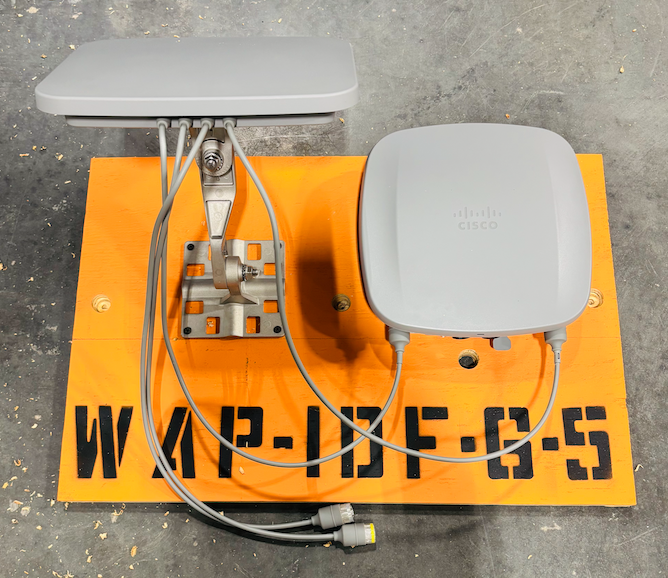

Memphis is one of the largest logistics and distribution hubs in the country. Between FedEx operations, regional distribution centers, manufacturing facilities, and third-party logistics providers, warehouse Wi-Fi is no longer “nice to have.” It is operational infrastructure.
Yet many warehouses across Memphis are still being deployed with omni-directional access points in environments where directional Wi-Fi design would perform dramatically better.
The result is predictable:
- poor roaming
- intermittent barcode scanner failures
- dead spots between aisles
- excessive co-channel interference
- unstable VoIP handsets
- unreliable forklift connectivity
- frustrated warehouse staff
The problem is not always the Wi-Fi vendor. In many cases, it is the antenna strategy.
The Core Problem with Omni Wi-Fi in Warehouses
Omni-directional antennas radiate signal in a broad 360-degree pattern. That works reasonably well in offices, classrooms, and open environments. Spray and Pray!
Warehouses are not open environments.
Modern warehouse spaces in Memphis typically include:
- 30–40 foot ceilings
- long metal rack aisles
- dense pallet storage
- reflective metal surfaces
- moving inventory
- high forklift traffic
- handheld scanning devices
An omni antenna mounted above warehouse racks throws RF energy everywhere:
- across multiple aisles
- into adjacent AP coverage zones
- into reflective metal surfaces
- into areas where clients should not connect
Instead of creating clean RF cells, you create RF spillover.
In warehouse environments, spillover is the enemy.
Why Directional Antennas Work Better
Directional antennas focus RF energy down specific aisles instead of broadcasting in all directions.
That changes everything.
A properly designed directional deployment:
- reduces co-channel interference
- improves roaming decisions
- stabilizes scanner connectivity
- increases SNR in active work areas
- limits sticky client behavior
- creates predictable coverage patterns
In practical terms:
- scanners reconnect faster
- forklifts stay online
- voice devices stop dropping calls
- roaming becomes reliable
This is especially important in large Memphis logistics facilities where workers may move continuously through long aisles at speed.
The “More Signal” Mistake
One of the most common misconceptions in warehouse Wi-Fi is:
“More signal equals better Wi-Fi.”
It usually does not.
In warehouses, too much overlapping signal creates:
- contention
- retransmissions
- excessive roaming overlap
- unstable client behavior
Warehouse Wi-Fi is about controlled RF propagation, not maximum coverage radius.
Directional designs intentionally constrain RF patterns.
That is a feature, not a limitation.
Memphis Warehouses Have Unique RF Challenges
Memphis facilities often present additional issues:
- older retrofitted buildings
- mixed construction materials
- massive distribution footprints
- hybrid freezer/dry storage
- high trailer turnover
- outdoor staging areas
Many deployments evolve over years:
- APs get added reactively
- power levels get increased
- omni antennas get stacked closer together
Eventually the warehouse has “full bars” but terrible performance.
Coverage is not capacity.
And visibility is not usability.
The Barcode Scanner Test
If you want to know whether your warehouse Wi-Fi is truly healthy, ignore the laptop speed test.
Watch the barcode scanners.
Scanners expose Wi-Fi problems faster than almost any other client device because they:
- roam aggressively
- often use lower-quality radios
- depend on low latency
- move continuously through aisles
If workers are rescanning inventory, waiting on transactions, or losing sessions during movement, your RF design likely has structural problems.
What a Proper Warehouse Design Looks Like
A modern warehouse Wi-Fi deployment should typically include:
- directional antennas down aisles
- predictive RF modeling
- validation surveys
- controlled transmit power
- channel reuse planning
- proper AP spacing
- roaming optimization
- client-aware design
This is engineering, not just installation.
Stop Treating Warehouses Like Office Buildings
Office Wi-Fi strategies do not translate directly to industrial environments.
Warehouses require:
- RF containment
- aisle-specific propagation
- mobility-aware roaming
- interference management
Omni-directional deployments frequently create more problems than they solve in large warehouse environments.
Especially in Memphis, where logistics operations depend on real-time mobility, the cost of unstable Wi-Fi quickly becomes operational downtime.
The industry needs to move past the idea that warehouse Wi-Fi is simply “putting access points on the ceiling.”
It is an RF engineering problem.
And directional design is usually the correct starting point.